
Public Hunting Area Map Online
To view hunting maps please visit: http://http://www.mvr.usace.army.mil/Missions/Recreation/LakeRedRock/Recreation/Hunting.aspx
With 52,000 acres of public land the Lake Red Rock area has great habitat for all types of hunting.

Lake Association Members: As a special perk of your support, we’re providing you this sneak peek at the next “Ask the Corps” article (to be published in the Pella Chronicle and Knoxville Journal-Express)
The Lake Red Rock area offers great hunting opportunities! Hunters can access about 25,000 acres of forest, prairie, upland and lowland habitats. Agricultural leased ground on government property is also open to hunting, and farmers are required to leave some standing crop as a wildlife food source.
The Iowa Department of Natural Resources (DNR) estimates upland game populations through the following surveys:
Roadside Counts: Every year, the DNR conducts roadside counts during the first 15 days of August. At least one 30-mile route is run in each county during the first 1 ½ to 2 hours of the day. The routes are the same as those run since the 1960s. Wildlife surveyed during the counts includes pheasant and other species such as quail and rabbits. Casey Trine, DNR Natural Resource Technician at the Red Rock Wildlife Unit reported, “The number of pheasant counted during this year’s survey increased 35-40% over the previous year; however, even though numbers are up, the counts are still low. Farmers are seeing more birds, but we need more mild winters and dry, warmer springs.”
Turkey brood surveys: Brood surveys take place in July and August each year. A postcard survey is mailed to wildlife professionals and hunters to collect information on area sightings. Trine said, “Preliminary numbers show turkey counts are up. They had a good hatch, and weather conditions were right.”
Title 36 Regulations and Hunting Maps
The Title 36 Code of Federal Regulations and the Iowa Department of Natural Resources game laws apply to all of Lake Red Rock’s huntable areas. The following are several of those laws and regulations that are particularly important to hunters. Please note that for a copy of Title 36 Regulations and a printed version of the hunting map, contact the Lake Red Rock Project office at 1105 HWY T15, Knoxville, Iowa 50138 or phone (641)828-7522 or (641)628-8690. For a complete list of game law information contact the Iowa Department of Natural Resources, Wallace State Office Building, Des Moines, Iowa 50319-0034.
Lake Red Rock Project office 1105 HWY T15 Knoxville, Iowa 50138 (641)828-7522 or (641)628-8690For a complete list of game laws:
Iowa DNR Wallace State Office Building Des Moines, Iowa 50319-0034 (515) 281-5918- The operation of a vehicle off roadways is prohibited.
- The improper disposal of garbage or litter, including waste water is prohibited.
- It is illegal to discharge a firearm within 200 yards of a building inhabited by people or domestic livestock or feedlot unless the owner has given permission.
- You cannot molest or disturb, in any manner, any den, lodge, or house of a fur bearing animal or beaver den.
- You can only use steel shot, copper or nickel coated steel shot or bismuth-tin shot to hunt any migratory waterfowl.
- If you are 16 years of age or older, you need a valid state and federal migratory waterfowl stamp (duck stamp) to hunt or take any migratory water fowl within Iowa.
- It is unlawful to shoot any rifle on or over any of the public waters or public highways of the state or any railroad right of way.
- You cannot shoot a shotgun with a slug load, pistol or revolver on or over a public roadway.
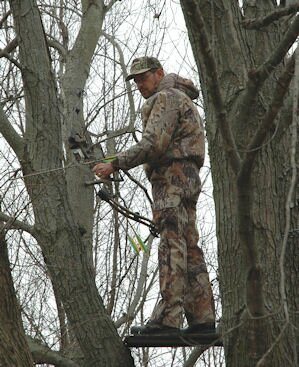
- The construction of permanent duck blinds or tree stands is prohibited. Portable stands and blinds are acceptable.
- All boats shall have safety equipment on board in compliance with State and U.S. Coast Guard boating and safety regulations.
- All boats, when not in use, shall be removed or securely moored at designated areas approved by the project office.
To Be A Responsible Sportsman, You Must Be Safe
The best way to insure a safe trip is to know and follow these rules.
- Treat every gun with the respect due a loaded gun.
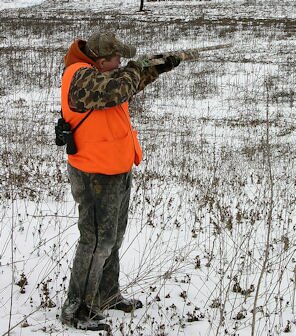
- Watch that muzzle! Carry your gun safely; keep the safety on until you are ready to shoot.
- Unload guns when they are not in use. Guns should be carried in a case to the shooting area.
- Be sure the barrel is free of obstructions and that you have the proper size ammunition for the size of the gun you carry.
- Obtain the landowner’s permission before hunting or trapping on their land.
- Be sure of your target before you pull the trigger.
- Never point a gun at anything you do not want to shoot; avoid horseplay.
- Never climb a tree or fence or jump a ditch with a loaded gun.
- Never shoot at hard flat surfaces or water as target practice and be sure your backstop is adequate.
- Store guns and ammunition separately, beyond the reach of children.
- Avoid alcoholic beverages before and during shooting.
- Dispose of animal carcasses properly.
- Support and help train new hunters and trappers.
- Avoid setting traps in areas where domestic animals may be caught.
- Support strict enforcement of regulations including hunting and trapping seasons.
- Report all game law violations to state or federal wildlife agencies.